 Log in


The Gemini exchange already paid a $5 million fine following the agency's lawsuit.

Kelli Cain and Brian Crabtree are celebrating the 20th anniversary of their monome company and project this week. For anyone moved by their creations over the years, there will be no escape from the feels in this gallery -- and, of course, I couldn't resist adding some extra memories from that era.
The post monome at 20: memories of the grid, in pictures appeared first on CDM Create Digital Music.
I'm not suggesting that a man like Pope Leo—the Vicar of Christ, the Bishop of Rome, the Servant of the Servants of God—would stoop to anything quite so base as "trolling" the onetime PayPal co-founder and current Antichrist alarmist Peter Thiel. But I'm also not not suggesting it, if you see what I mean.
How else to explain the novel appearance of Gandalf—yes, the pipe-smoking wizard!—in the pages of one of Catholicism's most important documents, a major papal encyclical about AI and technology? Perhaps Leo, who was born and raised in Chicago before spending decades in Peru, is simply a big J.R.R. Tolkien buff who can't get enough of magic rings, Eldar lore, and tricksy little hobbitses. Or perhaps Leo is sending a message.
In his new encyclical, released yesterday, Leo quotes one literary character in the entire 40,000-word document. It's Gandalf, doling out some of his wisdom in a scene from Return of the King: “It is not our part to master all the tides of the world, but to do what is in us for the succour of those years wherein we are set, uprooting the evil in the fields that we know, so that those who live after may have clean earth to till.”
Leo connects this speech with the "civilization of love" that he calls for in the document, stressing (as Tolkien did) the importance of "small and steadfast acts of fidelity that serve as a bulwark against dehumanization."
The Gandalf quote, innocuous on its own, feels more pointed when you realize how Tolkien is valorized (Valar-ized?) in conservative tech circles today. Peter Thiel is one of the most powerful people in such circles—and he is a Tolkien fanboy in the worst way.
As far back as 2012, people were running articles on how "Peter Thiel, the first outside investor in Facebook, is a huge fan of J.R.R. Tolkien's Lord of the Rings series of fantasy books."
Business Insider noted that "Thiel's inner circle seems well aware of his fondness for Tolkien's world of elves and magic. One source who claims to be close to Thiel says there's an in-joke about his venture-capital firm, the Founders Fund, being nicknamed 'The Precious.'"
Thiel has named many of his companies after Tolkien's world. He co-founded the AI-focused Palantir. He launched Mithril Capital Management. He co-founded the fintech venture capital firm Valar Ventures. He has other companies named Rivendell One and Lembas LLC.
Thiel protégés include current US Vice President J.D. Vance, who has called Tolkien his favorite author and who once founded a venture capital firm called Narya (one of the Elvish rings of power).
Palmer Luckey, who launched his own Tolkien-themed tech/defense startup called Anduril, is also "launching a new digital bank with backing from Peter Thiel," Fortune reported last year. The bank's name? Erebor, naturally, another name for the Lonely Mountain, where Smaug slept atop piles of gold in The Hobbit.
Thiel and his circle like a good fantasy story. So what? According to The New York Times, even the current leader of Italy, Giorgia Meloni, used to cosplay Tolkien characters and attend "Hobbit Camps," where she "sang along with the extremist folk band Compagnia dell’Anello, or Fellowship of the Ring."
But Thiel isn't just one more investor with a Tolkien fetish. He has also been proclaiming a fairly idiosyncratic version of Christianity for years. His message has recently taken the form of a multi-night, four-lecture series about the looming dangers of "the Antichrist," a figure drawn from the Book of Revelation who opposes everything Jesus stood for.
And he doesn't seem to be a big fan of the Pope.
Thiel's Antichrist tour has taken him around the world, including Rome, where earlier this year The Associated Press said that Thiel's "invitation-only conference" became "so controversial that the Catholic universities initially associated with it have all denied official involvement."
While the lectures have been private, recordings of them have leaked. The Guardian has a nice write-up on them, saying that Thiel's "beliefs are diffuse, meandering, and often confusing, but one tenet he’s steadfastly maintained over the years is that the unification of the world under one global state is essentially identical to the Antichrist."
Thiel worries especially about a "woke American pope" making common cause with a "woke American president," which could lead to the world domination he fears.
You can see how Thiel's ideas—I use the word with hesitation—might come to the attention of the current US-born Pope. But Popes don't generally stoop to Tolkien-quote battles with those who dislike them, so why now?
Perhaps it's because Thiel, despite his professed Christianity, represents a sort of tech messianism. It is technology that could save the world from the "stagnation" that grips it, he said repeatedly on a New York Times podcast interview in 2025. And the technology that could best help break this cultural stagnation is AI. Therefore, we should take the guardrails off AI, despite the risks.
I still think we should be trying AI, and that the alternative is just total stagnation. So yeah, there’s all sorts of interesting things can happen with—maybe drones in a military context are combined with AI. And OK, this is scary or dangerous or dystopian, or it’s going to change things. But if you don’t have AI, wow, there’s just nothing going on.
I'm old enough to remember life before AI. It certainly seemed like some things were going on. But to Thiel, people and governments who stand in the way of AI—especially if they in some sense represent the dreaded one-world governance of his nightmares—are themselves possible Antichrists.
If you think I'm making this theory sound crazier than it is, here's Thiel saying that his worries about "peace and safetyism"—i.e., regulation—are directly linked to the Antichrist:
But is this so preposterous, what I’ve just told you, as a broad account of the stagnation that the entire world has submitted to for 50 years of peace and safetyism? This is a 1 Thessalonians 5:3—the slogan of the Antichrist is peace and safety.
[Ed. note: The New Testament's first letter to the Thessalonians says, "You know very well that the day of the Lord will come like a thief in the night. While people are saying, 'Peace and safety,' destruction will come on them suddenly, as labor pains on a pregnant woman, and they will not escape." The quote emphasizes that the "day of the Lord" will be a total surprise, not that it was caused by people trying to stop wars or require airbags in cars.]
And we’ve submitted to—the FDA regulates not just drugs in the US, but de facto in the whole world because the rest of the world defers to the FDA. The Nuclear Regulatory Commission effectively regulates nuclear power plants all over the world.
In this view, Pope Leo's strident call to "disarm" AI is therefore aligned with the forces of stagnation that are used by the Antichrist to stage his or her world takeover.
Leo seems in his encyclical to be sketching a completely different vision, showing Thiel and his Silicon Valley friends that there's another way to "build." Not in a world-bestriding, revolutionary way that seeks to earn a billion dollars while strapping AI vision systems onto cruise missiles, but in a quieter way, with love and charity worked out in our local field of action.
Or, as Gandalf put it above, "to do what is in us for the succour of those years wherein we are set, uprooting the evil in the fields that we know, so that those who live after may have clean earth to till."
Leo thus calls for tech to shed its messianic and neo-colonial tendencies in order to serve humanity; Thiel instead sees tech as a savior to the poor and oppressed, a force that can head off Armageddon and Antichrist.
Thiel's vision of tech saving the world through unloosed, Saruman-style AI industrialists would be far more compelling if so many of these tech giants were not such strangely immature and insecure people.
But don't take my word for it. Here's Thiel himself, telling The New York Times' Ross Douthat about a meeting he once helped broker between top AI leader Demis Hassabis and Elon Musk:
The rough conversation was Demis telling Elon: I’m working on the most important project in the world. I’m building a superhuman A.I.
And Elon responds to Demis: Well, I’m working on the most important project in the world. I am turning us into interplanetary species.
And then Demis said: Well, you know my A.I. will be able to follow you to Mars.
And then Elon sort of went quiet...
Thiel himself sums up this meeting of the minds: "It was the dumbest meeting with Elon that we sort of brokered."
I'm not the only one to raise this question about the Pope's encyclical, of course.
The Catholic Herald asked, "Is Magnifica Humanitas aimed at Peter Thiel’s techno-political empire?"
Or, as tech blogger Simon Willison wrote, "I can’t help but wonder if the J.R.R. Tolkien quote from The Return of the King was the Pope throwing a little shade at Peter Thiel."
But I don't think this Pope operates according to categories like "throwing shade." As we saw when Leo tangled with Donald Trump over his war of choice in Iran, Leo sees his job as preaching and proclaiming.
"The mission of the Church is to proclaim the Gospel, to preach peace," Leo said at the time. "I simply hope to be listened to because of the value of the word of God."
His Gandalf quote may well be targeted at Thiel, or perhaps more broadly at those who think in similar ways. But it is not confrontational or insulting. It is a way of speaking across differences using a line drawn from a shared cultural resource between the two camps. It offers up a new interpretation of Tolkien's tremendous work to those who see in it a license for warfare, technological disruption, battles, and global action. Those things exist in the story, and they are exciting, but they are also terrifying and ultimately endured only for the purpose of defending community, hearth, and home.
In Tolkien's world, it is the "little people"—indeed, it is the wretched outcast Gollum—who finally save the world from the battles and technologies of the "great," and thus it is in the limited world of the hobbits that the action begins and ends.
It is in this sense, I think, that the Pope offers a different vision to the tech aristocrats of today. He explicitly asks them to give up their dreams of transhumanism and "artificial" intelligences—and to replace those dreams with something more truly human.
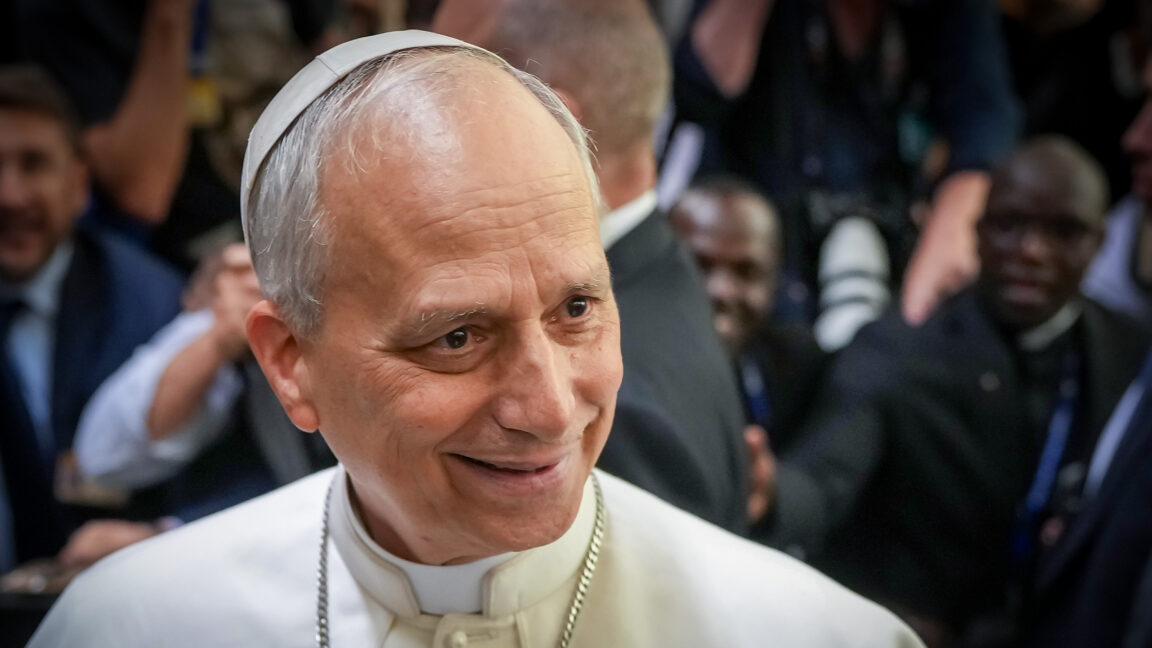
With the co-founder of Anthropic at his side today in Rome, Pope Leo XIV released a major new encyclical—his first—called Magnifica Humanitas (Magnificent Humanity). It calls for AI to be "disarmed" in service of the common good.
"The word is strong," Leo admits, but he chose the language of "disarmament" deliberately, "because this moment needs words capable of attracting attention, awakening consciences, and indicating paths forward for humanity." AI today must be "freed from logics that turn it into an instrument of domination, exclusion, and death."
The 40,000-word encyclical contains uncompromising critiques of AI-powered autonomous weapons, neo-colonial attitudes toward data collection, and the hoarding of "new forms of property, such as patents, algorithms, digital platforms, technological infrastructure, and data."
But the letter goes far beyond critique, updating Catholic social teaching in a way that calls on everyone to "build"—a favorite term of the Silicon Valley elite. (See venture capitalist Marc Andreessen's well-known 2020 essay, "It's Time to Build.")
In Leo's vision, though, this "building" extends beyond code or startups or factories or housing. He calls for nothing less than the creation of a "civilization of love" in which everyone works for the common good within their own sphere of life and in which technology does not dominate, exclude, or bypass humanity, but instead serves and augments it.
That is why, despite releasing it today, Leo actually signed the encyclical on May 15, the anniversary of a famous 1891 encyclical called Rerum Novarum (New Things). That older document set out Catholic social teaching during an era of capitalist upheaval, largely taking the side of workers and labor unions. Today, Leo updates the church's social teaching for the age of AI, which he sees as the "res novae of our time."
As his predecessor did 135 years ago, Leo warns that individual humans and humanity itself must not be left behind by technological advancements or by new forms of power. He is clear-eyed about the sway that technological elites hold today, comparing them to colonial conquerors.
Entire regions, especially those marked by structural fragility and limited geopolitical relevance, are currently subjected to a new mindset of extraction: that of health data, epidemiological profiles, genetic maps and demographic information. These have become the new “rare earths” of power: vital data which, once aggregated and analyzed, can be used to train predictive models, guide investment strategies, anticipate crises and, above all, determine who and what is deemed to matter.
Those who control the health data of entire peoples—often collected under the pretext of aid, research or innovation—possess a structural leverage over the future, for they can shape needs and markets. They can also decide, before others, to whom medicines, investments and protections will be allocated. Here lies one of the most urgent moral challenges of our time: to ensure that shared knowledge becomes a true common good rather than an instrument of dominance.
If we don't figure this out, Leo says, "the digital age will not be post-colonial, but colonial in another form."
Still, the Vatican is not opposed to AI as a tool. Indeed, this spring it rolled out an AI-powered system that will translate services at St. Peter's into 60 languages on people's smartphones.
But Magnifica Humanitas argues that AI must be kept in perspective, since "these systems merely imitate certain functions of human intelligence." While they may be faster thinkers, AI tools "do not undergo experiences, do not possess a body, do not feel joy or pain, do not mature through relationships, and do not know from within what love, work, friendship, or responsibility mean. Nor do they have a moral conscience."
That is why, Leo argues, we should not be led astray by AI's focus on "intelligence." Elevating one quality of the human person in this way can overshadow "other essential dimensions of life, such as affection, the will, commitment, and relationships." If you give humans mere technical power apart from wisdom, emotion, and relationships, Leo says, it "does not make us more capable; it makes us more isolated and more vulnerable to being dominated and excluded."
Because of this reality, AI must be "disarmed," Leo concludes, freeing it "from monopolistic control and opening it to discussion and debate, therefore making it human-friendly and restoring it to the plurality of human cultures and ways of life." Mere regulation is "insufficient."
The disarmament thus takes place as an ecological project, one that situates AI within the broad sweep of human culture and that orients it toward human flourishing, not toward warfare, monopolistic power, or new inequalities. It calls upon us simultaneously to resist technological domination and to build through "small and steadfast acts of fidelity that serve as a bulwark against dehumanization."
To adopt the mindset needed to build this new "civilization of love," Leo suggests five pathways that individuals and institutions can each embrace: the need to disarm words, building peace through justice, adopting the perspective of victims, cultivating a healthy realism, and reviving dialogue and multilateralism.
In sounding this call to both disarm and to build, Leo turns to "twentieth-century Catholic author" JRR Tolkien. Though he can't quite bring himself to say that he's quoting Gandalf from Lord of the Rings, that's exactly what's happening.
(The encyclical says only that the quote comes from "the words of a protagonist in one of [Tolkien's] novels." Though Pope Francis previously spoke of Tolkien's work, this appears to be the first time that Tolkien has ever been quoted in the highest levels of the church's official doctrinal publications.)
Gandalf says, in what is very much a theme of the entire Lord of the Rings:
It is not our part to master all the tides of the world, but to do what is in us for the succour of those years wherein we are set, uprooting the evil in the fields that we know, so that those who live after may have clean earth to till.
The moral and local action envisioned here, along with Tolkien's suspicion of the dehumanizing effects of technology, clearly appealed to Leo.
Still, the Church knows its place, Leo says, and does not wish to dictate. Religion does not possess "technical answers, nor do we seek to displace those with expertise," he writes. "But we bring a wisdom concerning the human that our present time desperately needs: every person is unique and irreplaceable, a free and intelligent subject with a conscience, capable of seeking God, serving one another, caring for our common home."
Leo asks everyone who reads the document to make a commitment to "stay awake and, as 'artisans of hope,' to keep on building the worksite of our time."
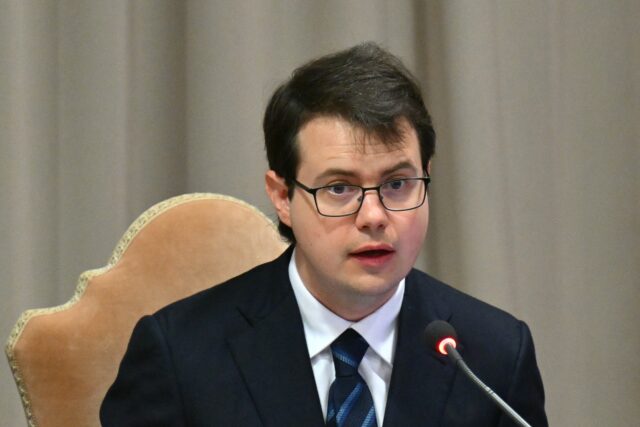 Anthropic co-founder Christopher Olah speaking at the Vatican.
Credit:
Getty Images
Anthropic co-founder Christopher Olah speaking at the Vatican.
Credit:
Getty Images
Anthropic co-founder Chris Olah called the document "timely," pointing to three questions that he most wants religious and moral leaders to help the AI industry think through.
The first is our duty to the global poor. There is a real possibility that AI will displace human labor at very large scale. If that happens, supporting those displaced will be a moral imperative of historic proportions. This task will be difficult enough, but I worry most dialogue misses an even harder challenge. AI development is concentrated in a handful of wealthy nations. How can we ensure the gains of AI are shared globally? We do not have a mechanism for this. It is an unsolved problem, and it is the kind of problem the Church has historically refused to let the world ignore.
The second is the need for moral imagination and ambition regarding human flourishing. If AI models are going to be widespread, what does it look like for humans, families, and the world to flourish?...
The third is the need for discernment on the nature of AI models. I am a scientist. I lead a research team that studies the internal structure of these models—what is actually happening inside them. And I will be honest: we keep finding things that are mysterious, even unsettling. We find structures that mirror results from human neuroscience. We find evidence of introspection. We find internal states that functionally mirror joy, satisfaction, fear, grief, and unease. I don’t know what that means, but I think it warrants ongoing discernment.
When releasing Magnifica Humanitas today, Pope Leo thanked Olah for attending and added that they would keep in touch.
"I accept your invitation to walk together," the Pope said, "to listen and to speak and together to find the way for humanity in this time of artificial intelligence."
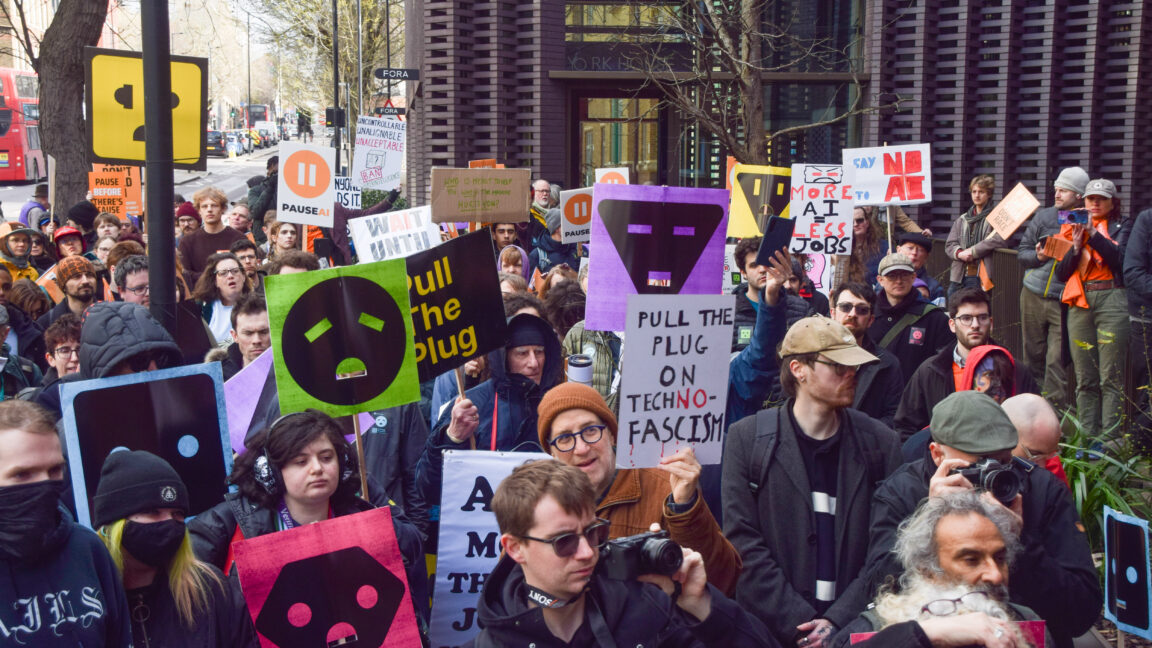
In the wake of attacks on CEOs, a nationwide protest movement targeting data centers, and increasing concerns about AI job replacement, federal intelligence agencies and domestic law enforcement are circulating reports with a new domestic target in mind: anti-technology extremists.
More than 1,000 pages of unpublished reports from the Department of Homeland Security, FBI, and fusion centers obtained by WIRED show a national shift taking place to surveil this new and worryingly broad category of people and activities deemed an emerging threat.
This new effort follows President Donald Trump's National Security Presidential Memo 7, which instructs the Department of Justice to target anyone holding “anti-American,” “anti-Christian,” and "anti-capitalism” beliefs. Earlier this month, Trump's counterterrorism czar, Sebastian Gorka, released a public counterterrorism strategy claiming that left-wing extremists are one of the three top counterterrorism priorities facing the United States.
Taken together, these Trump administration directives have commandeered the domestic surveillance apparatus to surveil and criminalize speech and assembly that challenges the ideology of the White House. A new focus on anti-technology extremism adds an unreported category to already public designations under a presidency that has heavily invested political and material capital in AI and data center proliferation.
Among the documents in the tranche obtained by WIRED is a New York Intelligence and Counterterrorism Bureau report that warns of widespread upheaval in response to AI adoption. Of particular note is a novel term for what the bureau purports to be an emerging extremism threat.
"The chaotic atmosphere that may result from emergent AI technology in the next five years may fuel large-scale protests that devolve into civil unrest and anti-tech violent extremist activity, especially in large urban areas such as New York City," the report reads. The term "anti-tech violent extremism" does not appear in any publicly available DHS or FBI domestic extremism reports or guides and represents a novel grouping of a wide range of ideologies under a single extremist category.
In the same Intelligence Bureau assessment, analysts also describe a novel threat emerging in the wake of the arrest and trial of Ziz Laota, an extreme rationalist who allegedly led a small cultlike group, three members of which have been charged with murder, tied to an obsessive ideology focused on the existential risk posed by AI.
While the Zizian ideology is extremist in nature, a less extreme version of the same fears surrounding the cataclysmic potential of AI are a common concern among AI alignment experts, machine learning engineers, and even frontier AI companies. Nonetheless, the Intelligence Bureau warns that "paranoid views regarding AI" may proliferate in the aftermath of the Zizians' trial, thanks to their "attempt to reason the belief that a godlike incarnation of AI is imminent," and belief that "humans must best use their time in the present to devote themselves to ensuring its compliance with human morality, or face existential consequences for failing to do so."
The NYPD intel assessment follows the department’s collaboration with the FBI last year to monitor the Signal chat of an activist group coordinating volunteers to monitor public hearings at immigration courts in New York. According to documents obtained by The Guardian, the FBI surveilled activists as part of a broader investigation into "anarchist violent extremist actors," one of the threat categories named in the new counter terrorism strategy.
Created in the wake of 9/11, 80 fusion centers now pockmark the country and serve as go-betweens for federal intelligence agencies and state and local law enforcement. In addition to concerns about portions of the American populace disturbed by the rapid proliferation of AI, these centers are also gathering and circulating “intelligence” about alleged threats to data centers.
A Western Pensylvania fusion center, for example, claimed that "adversarial actors, including state-sponsored entities, criminal groups, and extremists, such as homegrown violent extremists or environmental extremists, may target US data centers" and that "these actors could also exploit the strategic importance of data centers to the US economy, using them for activities like cryptocurrency mining or leveraging third-party entities, such as front companies, to gain access to US data and infrastructure."
A report from the Northern Virginia Regional Intelligence Center warned that AGAAVEs—anti-government, anti-authority violent extremists—influenced by government-related grievances and conspiracy theories, have engaged in pre-operational planning targeting data centers and other critical infrastructure facilities to disrupt government operations. But in the breakdown of Suspicious Activity Reporting indicators, the intelligence report lists activities that could easily be carried out by peaceful protesters, legal experts say.
"These intelligence reports are part of a long tradition of agencies identifying protest or even simply having strong opinions as precursors to violence," Spencer Reynolds, senior counsel at the NAACP Legal Defense Fund, tells WIRED. “Suspicious activity reports are incredibly unreliable, often about vague or innocent behavior, issued under permissive standards. These reports, often received in large volumes, allow officers to inject their own biases and see what they want to see in the facts.”
Among the vaguely defined activities flagged by the Northern Virginia intelligence center as suspicious are "expressed/implied threat," "observation/surveillance," "photography," "testing/probing of security," and "attempted intrusion."
“The FBI investigates individuals who commit or intend to commit violence and criminal activity that constitutes a federal crime or poses a threat to national security,” the FBI wrote in a statement to WIRED. “We have no additional comment.”
The Department of Homeland Security did not respond to WIRED's request for comment.
Meanwhile, the same intelligence center also circulated a report in March showing monitoring of constitutionally protected events and demonstrations related to critical views on technology. These events included multiple "Tesla Takedown" protests against Elon Musk’s ransacking of the US government and a “Break Up With Tech Rager" sponsored by Eject Elbit, an activist group organizing to halt investment in the Israeli weapons manufacturer Elbit.
In addition to intelligence analysts working inside fusion centers and federal law enforcement agencies, open source intelligence companies that contract with federal law enforcement agencies appear to be scouring the web for what they claim to be anti-technology sentiment as well. In January 2025, SITE Intelligence circulated bulletins to fusion centers alleging that conversations in a "neo-Luddite" Discord server had turned violent, with one user of the group called for violence against tech CEOs and power plants.
"SITE is a for-profit private intelligence firm that monitors social media for its law enforcement customers. It promises to do an incredibly difficult if not impossible job, consistently mining social media written by anonymous posters, full of in-jokes, slang, different languages, vagueness, and so on, to deliver credible information that can predict threats," Reynolds says. "Instead, this type of activity tends to focus on people's views about things like policing, abortion, economic inequality, vaccines, or any other hot-button topic of the day."
“By narrowing our OSINT focus exclusively to communities with a proven link to real-world harm, even trolling remarks have an informative value, demonstrating sentiment within a community toward a target, and our reports have shown a notable spike in online threats advocating for sabotage against data centers, which is a true cause for concern,” Rita Katz, founder of SITE, tells WIRED in an email.
The documents obtained by WIRED also show that fusion centers are currently keeping tabs on in-person assemblies. The Northern Virginia center generated a report about demonstrations at local civic events, including the Arlington County budget meeting and the Fairfax County School Board meeting. Across the country, town halls and budget committee meetings have been among the chief forums for local residents to express their dissent with data centers being built in their neighborhoods.
According to Data Center Watch, a project by AI security firm 10a Labs that tracks opposition to data centers, hundreds of organizations across 42 states have organized to block data center construction in their towns and counties. These efforts are often contentious. In California, Illinois, Indiana, New Jersey, Oklahoma, and Wisconsin, state and local police have removed or arrested speakers at town halls who criticize data centers, in one case before they were even allowed to speak.
Under US law, domestic terrorism is not a stand-alone crime that is brought to bear during trial. Instead, domestic terrorism laws allow for targeting and surveillance of extremists, with charges sometimes bearing terrorism enhancements and sometimes excluding them altogether. This has led to protesters and activists being surveilled under domestic extremism provisions while being charged with crimes like criminal trespass and vandalism.
The zeroing in on anti-tech activity by federal agencies is evident in an invitation to a lecture by extremism researcher Mauro Lubrano circulating in fusion centers across the country. Lubrano has emerged as one of the foremost experts on anti-technology extremism. He is the author of Stop the Machines: The Rise of Anti-Technology, which describes three main strains of a newly minted threat matrix: insurrectionary anarchists, eco-extremists, and ecofascists.
Lubrano's book identifies followers of “Unabomber” Ted Kaczynski, German anarchists, Mexican eco-extremists, and far-right fascists in the Terrorgram Collective as distinct but aligned components of an emerging tech extremism movement. In Lubrano’s analysis, these groups are united by the fact that they have all plotted or carried out acts of violence in furtherance of their ideological goals.
Lubrano said he was not surprised that his lecture turned up in a fusion center but cautioned that any anti-tech extremism framework must be exercised carefully. “I hope the warning I, along with other colleagues, raised is being acknowledged. While anti-technology violence is unacceptable, it should not be used as an excuse to securitize AI and emerging technologies, thereby silencing those who are critical of the current trajectory,” Lubrao tells WIRED.
But Spencer Reynolds says that, despite the real, if limited, threat posed by these groups, a category like “anti-tech extremism” could be drawn so broad as to ensnare peaceful data center protesters, AI skeptics, and anyone with a bone to pick with technology that permeates modern life.
“As people continue to organize for a better future, we're likely to see more surveillance and criminalization of this opposition, just as we have of Black Lives Matter, Occupy Wall Street, and environmental movements in recent decades,” Reynolds says.
A January 2025 DHS Office of Intelligence and Analysis report furthers this perspective by attempting to connect Luigi Mangione—the alleged assassin of UnitedHealth CEO Brian Thompson—with Kaczynski. “Law enforcement reports that the individual may have drawn inspiration from Ted Kaczynski (the Unabomber) and his anti-technology beliefs,” the report reads, without offering further evidence. It concludes with a warning alleging that executives “are at a heightened risk for targeted acts of violence or threats of violence” when they are “perceived as taking advantage of individuals of lesser means.”
But perhaps the clearest-cut example of how nonviolent critiques of technology can be swept up and flagged as a threat is found in an open-source report circulated by SITE Intelligence in April 2025. The report flags a video from the progressive nonprofit More Perfect Union on the destructive effects of a data center to nearby residents in Georgia. Nothing in the video advocated for violence against property or people. But thanks to fusion center targeting, the advocacy group is now circulating among US intelligence and law enforcement across the country as a potential threat vector.
This story originally appeared at WIRED.com.

Some time ago, I noted that the Process.StandardOutput property is an attractive nuisance because it is valid only on Process objects that you called Start on. You can’t just grab any old Process object and try to access its standard handles.
Others in the comments had their ideas on how to remove the confusion. Here’s mine. The principle is that the properties and methods of the Process object should be valid for all instances of the Process class. If a property or method is valid only conditionally, then either move it to a place that is accessible only if the condition is met, or get rid of it entirely if it adds no value.
The standard handles are the three properties that make sense only for Process objects that were created by the static Start method. There are also four methods related to those standard handles, as well as two events. Move them all to a new class, call it ProcessStartResult:
class ProcessStartResult
{
    public Process Process { get; }
    public System.IO.StreamWriter StandardInput { get; }
    public System.IO.StreamWriter StandardOutput { get; }
    public System.IO.StreamWriter StandardError { get; }

    public void BeginOutputReadLine();
    public void CancelOutputReadLine();
    public event DataReceivedEventHandler? OutputDataReceived;

    public void BeginErrorReadLine();
    public void CancelErrorReadLine();
    public event DataReceivedEventHandler? ErrorDataReceived;
}
Change the signature of all the overloads of the Start method so that they return a ProcessStartResult instead of a Process. Now it is impossible to do anything with the standard handles from a process you didn’t start: If you didn’t start the process, then you don’t have a ProcessStartResult. This removes the confusion that existed in the original attempt to have a process read from its own standard output.
This follows a principle I wrote about earlier: To force the developer to do things in a certain order, make the second step dependent on something produced by the first step. In this case, we want to force the developer to call Start before they use the standard handles, so we put the members related to the standard handles on a thing that you can obtain only by calling Start.
Next, remove the StartInfo property entirely. It serves two purposes:
Start method, it provides a convenient pre-made ProcessStartInfo.Start method, it holds a copy of the parameters that you passed to the Start method.The first purpose is just to cover for people who are too lazy to write the new keyword. So don’t be lazy. Write new ProcessStartInfo().
The second purpose doesn’t tell you anything you don’t already know, since you are the one who passed the parameters to the Start method in the first place. If they are so important to you, you can save them yourself.
Removing the StartInfo avoids confusion over whether the properties in it describe the process you want to start, or whether they describe a process that has already started. (And often, it describes neither!)
I think that takes care of the largest source of confusion over the proper use of the Process class.
The post A hypothetical redesign of <CODE>System.<WBR>Diagnostics.<WBR>Process</CODE> to avoid confusion over properties that are valid only when you are the one who called <CODE>Start</CODE> appeared first on The Old New Thing.


 reply
reply

